

History
The Old West Side and its historic district.
(Continued from Home Page)
The Old West Side Historic District within the Old West Side neighborhood was designated as such for its essential character as a unique community of homes. The physical environment is characterized by its small single-family homes situated on tree-lined streets.
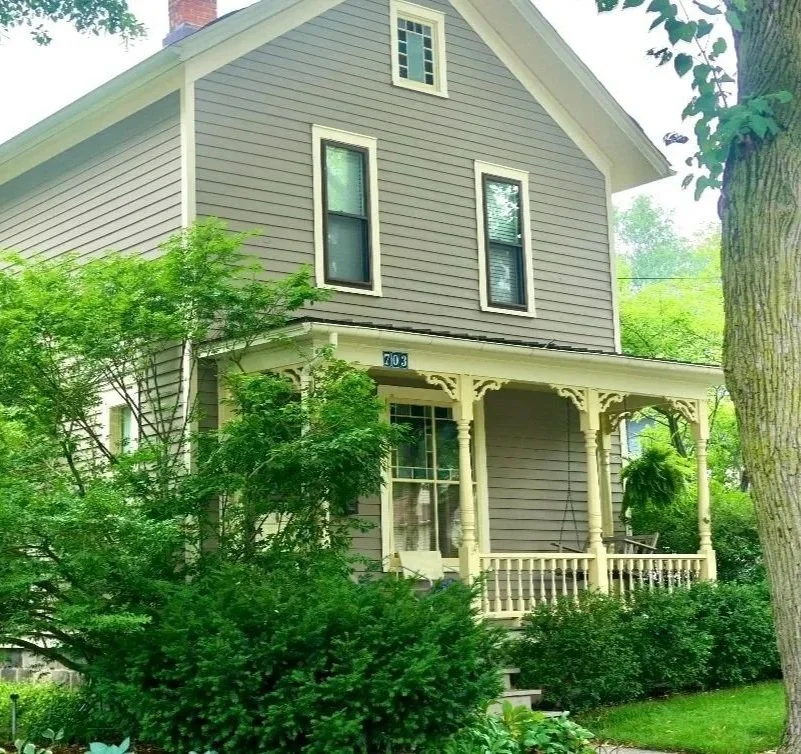
About 85 percent of the houses are of frame construction. A majority have clapboard exteriors, some have facades of shingles or stucco, and about 15 percent are brick. The typical house is rectangular, two stories high, with six or seven rooms. It has a front gabled roof, a pillared front porch, and ornament on the porch, gable, and around the windows. The larger houses are generally irregular in plan, have front and side porches, have more details and protrusions, and are more elaborately ornamented. The outstanding character of all of the homes lies in the variety of ornament of all styles, shapes, and textures, generally of machine-tooled wood.
Nearly every style prevalent in the United States during the Gilded Age and its aftermath (1860-1914) is represented in the Old West Side. The larger houses tend to predominate along W. Liberty and W. Huron. Represented are Gothic cottages, Romanesque villas, Italianate bracket houses, Colonial and Georgian revival mansions, Queen Anne, American picturesque, Tudor, stick, mansard, Greek revival, and "carpenter's delight" houses. Although these two streets contain the largest and most elaborate homes, other large homes appear throughout the area.
The smaller homes predominate on most of the other streets of the neighborhood. The architecture is less varied but in many cases equally interesting due to the subtle changes in detail and ornament from house to house. The predominant smaller house styles are simple vernacular Greek Revival (which are some of the oldest homes on the OWS, dating from the 1850s), scaled-down Italianate, Queen Anne ornamental houses, classic revival (generally less ornamental houses), small plain New England, and colonial revival.
Many homes do not fit exactly into these styles but are an eclectic mixture. Unlike many 20th century houses that are oriented to enclosed private back yards, the orientation of most Old West Side houses is to the neighborhood, with their porches fronting the street. Wooden ornament is the outstanding feature; while such ornament was characteristic of the period 1860-1910, the large amount used in the Old West Side suggests that the early German residents found this decoration congenial. The modest houses, their front porches, their interesting and varied ornament, and the pleasing relationship between building and landscape exemplify the character of the neighborhood.
One distinct small house area – the Mulholland/Murray Avenues section – should be noted. Streets are lined on both sides with small, closely-placed classic revival homes. A developer's area, the homes are built with porches close to the street. It is a typical, excellently preserved worker's house neighborhood of the 1890s.
The topography of the OWS is characteristic of Ann Arbor in that it is sloped slightly down to the northeast with undulations typical of the glacial moraine geology of the area. The eastern boundary of most of the OWS is the railroad track, which follows the course of Allen Creek, now buried in underground pipes, as it courses northward into the Huron River. Several tributaries of Allen Creek run through the OWS from west to east, also mostly buried in underground pipes.
Most of the older major streets are laid out in a grid that matches compass lines, with two exceptions: West Liberty shows its origins as a trail and runs southwest-northeast, and newer blocks in the southern and western portions exhibit curving streets and cul-de-sacs popular at the time of their creation.
To learn more, see the additional resources, below. If you have trouble locating any of them online or at the Ann Arbor District Library, feel free to reach out to us at oldwestsidea2@gmail.com for assistance.
You may also find an extensive bibliography on Ann Arbor history at the Ann Arbor Preservation Alliance.
Additional resources to explore the history of the Old West Side
Surveys and Reports, City of Ann Arbor’s Historic Preservation Surveys and Reports web page (Scroll down to the Old West Side section to view eight reports on the OWS, including six Survey Forms, which contain house-by-house information such as whether a structure is “contributing” or “non-contributing” and year of construction. Learn about all the houses on your block!).
Old West Side, Ann Arbor, Michigan: A Report on the Environmental Survey of a Neighborhood, Richard G. Wilson, Edward J. Vaughn, Mrs. George E. Downing, Old West Side Association, 1971 (Research supporting the application to get on the National Register and for historic district designation. A snapshot of the Old West Side on the cusp of becoming a historic district.).
“Smart Tour” of the Old West Side, Ann Arbor District Library (A deep dive into particularly notable structures, which you can take as a walking tour.).
Cabbage Town, The History of the Old West Side, Ann Arbor MI, Dave’s TV Zone (Video c. 1990s on the German origins of the OWS from 1846).
The Rise and Fall of Allen’s Creek, Ann Arbor District Library (An article about the history of Allen Creek and its impact on the topography and development of the OWS.).
Ann Arbor History: A Bibliography, Ann Arbor Preservation Alliance web page (Learn about other historic districts and Ann Arbor history in general.).