


Welcome to the Old West Side Association
Connecting Neighbors, Preserving History.

The Old West Side, the Historic District and the Association
Ann Arbor’s Old West Side is both an officially-designated historic district of 900 properties and a larger surrounding neighborhood adjacent to and west of downtown. The total area comprises more than 1,500 households, making it the largest neighborhood association in Ann Arbor.
The whole Old West Side is a 250-acre, primarily residential area characterized by the 19th- and early 20th-century architecture built largely by working-class German immigrants. One of the early names for the area was “Cabbage Town.” Borders are roughly Huron Street, the railroad/Main Street, Pauline Boulevard and a line running south from the Dexter Road and Jackson Avenue split from Huron street. Some say the borders are West Park, the railroad, Allmendinger Park, and what has become Eberwhite Woods and Virginia Park. In fact, the designation most closely matches the Old Second Ward voting district in place before April of 1956.
What is now the Old West Side grew out from the original town along the Huron River. German immigrants, primarily from Swabia, began settling the area starting around 1829, establishing businesses and working in local industries near Allen’s Creek. These included factories, tanneries and shops. Farms such as the one owned by Eber White filled the fringe lands west of town.
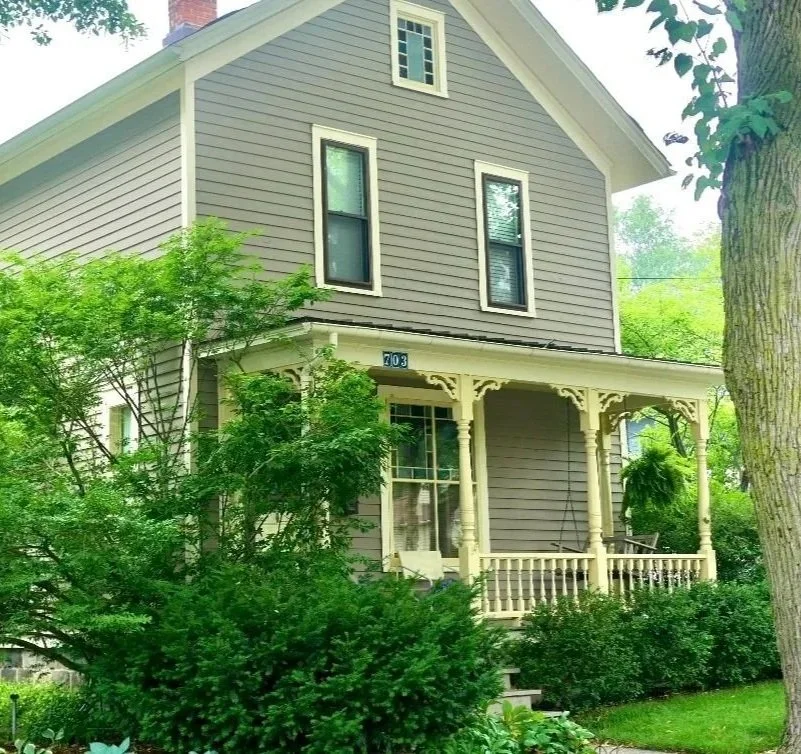
Merchant and real estate developer William S. Maynard subdivided much of the core neighborhood between First and Seventh Streets starting in 1845 and continuing through the 1860s, creating uniform residential lots. Later, speculators like Judge William Murray and his father-in-law, David Allmendinger, who owned a farm on Allen’s Creek as well as an organ factory, platted more streets before World War I to house workers and those who managed various businesses. As a result, architecture is diverse. Houses generally feature styles popular between 1860 and 1914, including Italianate, Queen Anne, Colonial Revival, Bungalow, and Gothic framework or vernacular homes.
Following World War I and continuing through the Great Depression and World War II, parts of the neighborhood experienced economic decline. Many large as well as typical single-family homes were subdivided into multi-family apartments or rooming houses as owners struggled to pay bills. At the time, most mortgages were privately held.
In 1967, long-time residents concerned by urban renewal pressures, proposed changes to the historic fabric, and a loss of identity, formed the Old West Side Association. Harry Koch and others organized neighbors while seeking advice from faculty members at the University of Michigan and the professional community serving downtown. A select group produced a study urging recognition of the unique streetscape of this working class community. The Old West Side was officially listed on the National Register of Historic Places on April 14, 1972, for its intact streetscape of diverse properties—the first in the country to be so acknowledged.
A local preservation ordinance followed in 1978, protecting structures within the historic district from unauthorized changes. This City provision was made possible by passage of Michigan Public Act 169 of 1970. This enabling statute, known as the Local Historic Districts Act, allowed cities, villages, townships, and counties across Michigan to form local historic districts governed by local historic district commissions. It is the local historic district commissions that have the authority to review proposed work within a district and issue a "certificate of appropriateness" before permits are granted.
Local provisions continue to evolve. The final form of the Ann Arbor law and what is protected under it were set in place in 2007. A 2011 survey of contributing properties (protected) and noncontributing properties (not protected) completed the City’s data on the Old West Side Historic District.
The larger neighborhood remains one of the most iconic in Ann Arbor. Known for its walkable, tree-lined streets, the area is prized. Homes have ready access to landmarks, attractions and downtown. Long-time residents, students, new families, and renters keep occupancy percentages in the high nineties. There is a keen sense of community and community service.
The mission of the Old West Side Association is to 1) support preservation in the historic district and the surrounding neighborhood and 2) promote community cohesion. Since the late 1960s, the Old West Side Association has worked with city planning task forces, supported residents for service on the Historic District Commission and sponsored events to celebrate, educate and preserve the neighborhood.
We meet with city officials to address policy concerns and provide forums for neighborhood meetings and community gatherings. Topics include local developments, zoning changes, city land-use planning, and other items of interest. We also foster community-building activities and traditions, such as newsletters (now our website), ice cream socials, volunteer-driven historic homes tours, and block parties.
The Association is now focused on bringing residents together to determine what forms events and activities will take moving forward. Support is growing both in terms of donations and numbers of individuals offering their time.
Upcoming events in the Old West Side:
The OWSA Seeks Volunteers to Re-Launch Longstanding Old West Side Homes Tour. Click image for details.

Visit Art Hop!'s 2026 Holiday Shop on December 13th. Click image for details!

Larry and Lucie Nisson, glass artists, are the first in our Notable Neighbors series. Click above and meet them!

Richard Norton Explains How Planning and Zoning Shape Ann Arbor’s Future at the OWSA's Fall meeting, October 22. Click above to learn more.

JOIN US
Membership is open to all residents and friends of the Old West Side! Get on our email list to keep up on news and events, and let us know how you’d like to be involved!

RESIDENT RESOURCES
Find resources for current residents, including neighborhood amenities and attractions, the history of the OWS, historic district information, tax credit programs, and frequently-asked questions.

OWS News
Explore the Old West Side News digital archives, hosted by the Ann Arbor District Library, and check out new stories and notices.
Shown on map, location of Bach Elementary School, the approximate center of the Old West Side neighborhood in Ann Arbor, Michigan.