

By Peter terHorst
Land-use decisions should follow a community’s long-term plan, not be driven by individual development goals, University of Michigan Professor Richard Norton told an audience of Old West Side Association residents on October 22.
Speaking at West Side United Methodist Church, Norton examined the history, legal foundations, and practical challenges of community land-use planning and zoning in Michigan. His central message was straightforward: Cities and communities should plan first, then use zoning regulations and public infrastructure investments to carry out their goals.
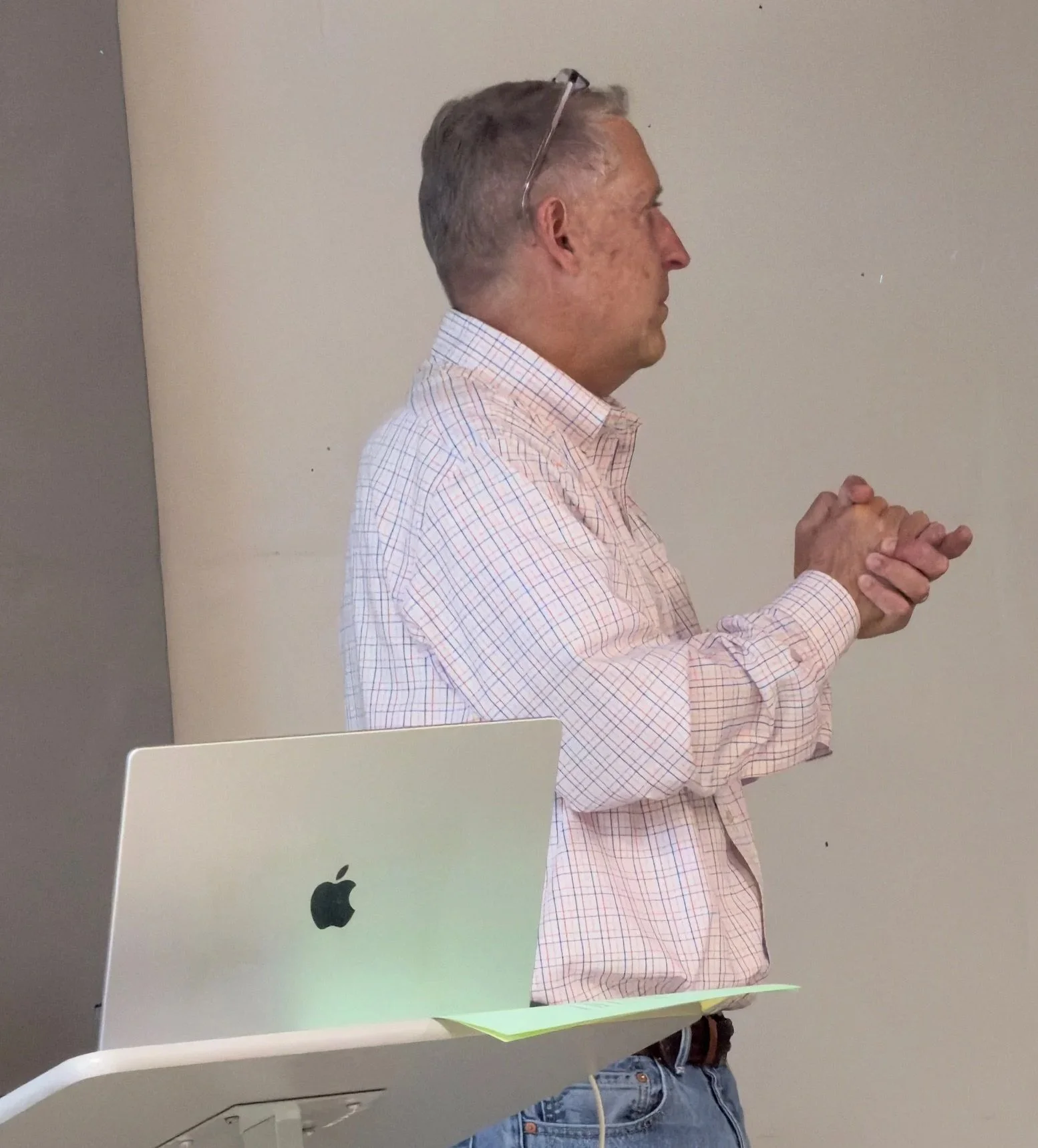
U-M Professor of urban planning Richard Norton presenting at the OWSA’s Fall Meeting
Norton outlined the legal rules governing zoning, including the roles of local governments, planning commissions and other decision-making bodies. Officials must follow established standards and procedures. Neighborhood opposition, he noted, is not necessarily a sufficient reason to deny a project that meets applicable requirements.
Norton explained a master plan should be more than a document on a shelf. It should reflect community values, evidence about existing conditions and a reasoned vision for the future.
“We use planning to find facts,” he said. “What are the trends? What are the problems we're dealing with? What are the issues that are of concern to the community? We collect information on the community's values and document the goals that we're trying to reach. We combine those facts with goals to set policies and then we document the process used.”
A good plan, Norton said, should provide a consistent starting point for decisions about individual development proposals, but also be flexible enough to respond to changing circumstances.
Norton traced the evolution of zoning from its early purpose of separating incompatible land uses, to the postwar emphasis on single-family subdivisions, separation of activities and automobile-dependent development. He noted that the history of zoning often included racial and economic exclusion, and he urged residents and officials to examine claims about “neighborhood character” and declining property values rather than automatically accepting them.
Housing affordability was another major theme. Zoning can determine what kinds of homes may be built, Norton observed, but allowing apartments or other housing does not guarantee that construction will follow. Building costs, financing, market conditions and disparities in wealth also influence who can afford to live in Ann Arbor.
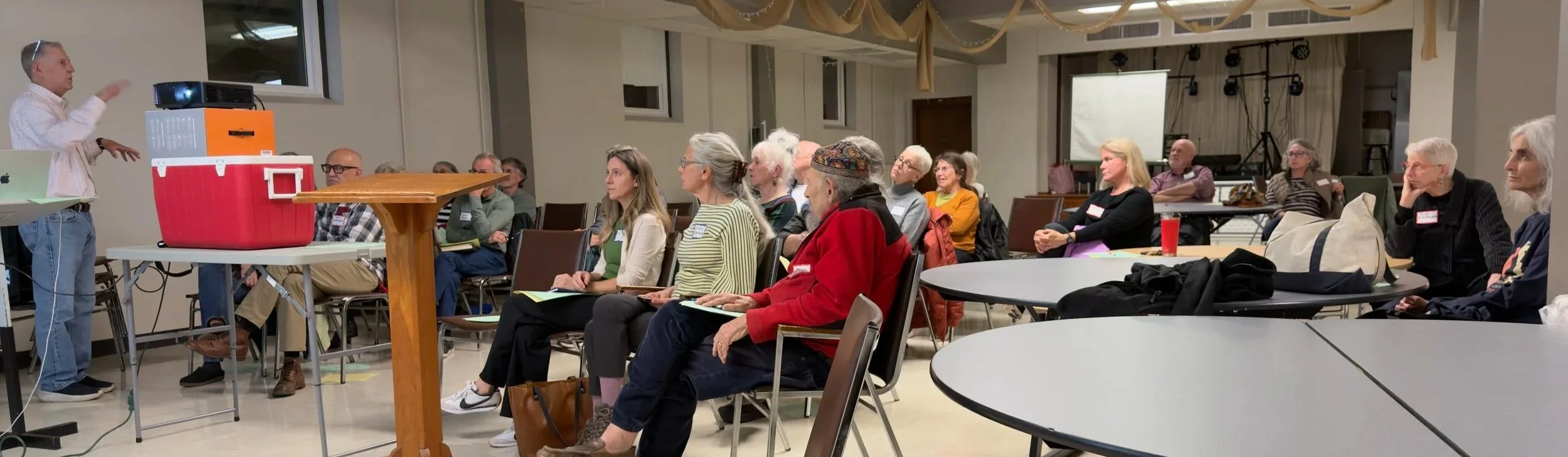
OWSA members enjoying learning more about land use planning and zoning at the OWSA’s Fall meeting at United Methodist Church, October 22, 2026
He also emphasized the close relationship between development and public infrastructure. Stormwater drainage, aging utilities, heavier rainfall and other environmental pressures must be considered alongside decisions about where and how communities grow.
Throughout the presentation, Norton returned to the difficult balance between protecting existing neighborhoods and accommodating future residents, between consistent rules and flexibility, and between meaningful public participation and workable decision-making.
“The challenge we face as a city moving forward is trying to figure out how to navigate the transition from what Ann Arbor was in 1880, keep the desirable things that we love about the city, but recognize we're moving forward into a different world with different expectations, different needs,” Norton said.
His broader point was that planning is not simply a technical exercise in drawing zoning boundaries. It is a public process that shapes housing choices, transportation, neighborhood life and the community’s ability to adapt to future needs.
Norton noted that his remarks represented his personal views, not official positions of the Ann Arbor Planning Commission or legal advice for the city.
++++
Richard K. Norton is a professor of urban and regional planning at the University of Michigan’s Taubman College of Architecture and Urban Planning. He holds a joint appointment as a professor in the Program in the Environment through U-M’s College of Literature, Science, and the Arts and School for Environment and Sustainability. Norton contributes actively to public service through community-engaged research and teaching, and by serving on the planning law committee of the Michigan Association of Planning. For more, visit https://taubmancollege.umich.edu/faculty/directory/richard-norton/.
Dr. Norton had previously made this presentation to the City Planning Commission, video here.